
 Mirror
A chandelier does something no other fixture can — it declares the character of a room before you've noticed the furniture, the art, or the paint color. Get it right, and the entire space coheres around it.
A chandelier does something no other fixture can — it declares the character of a room before you’ve noticed the furniture, the art, or the paint color. Get it right, and the entire space coheres around it. Get it wrong — too small, too large, wrong style, wrong height — and every other design decision in the room fights an uphill battle.
This is the complete guide to choosing a luxury chandelier: the sizing formulas designers actually use, the style categories that matter, the finish decisions that tie a room together, and the installation details that separate a confident choice from a costly mistake. Whether you’re selecting your first chandelier or replacing one that never felt right, this guide gives you the framework to choose with precision.
How to Size a Chandelier for Any Room
Size is the single most common chandelier mistake — and the hardest to fix after installation. An undersized chandelier disappears. An oversized one overwhelms. The right chandelier fills the visual space of a room without crowding it.
The Room Dimension Formula
The industry-standard sizing formula is simple: add the room’s length and width in feet — that number in inches is your ideal chandelier diameter.
| Room Size | Recommended Diameter | Example |
|---|---|---|
| 10′ x 10′ | 20 inches | Powder room, walk-in closet |
| 12′ x 14′ | 26 inches | Standard dining room |
| 14′ x 18′ | 32 inches | Large dining or living room |
| 16′ x 20′ | 36 inches | Great room, open plan |
| 20′ x 24′ | 44 inches | Grand foyer, ballroom |
For chandeliers over a dining table specifically, use the table width instead: the chandelier diameter should be one-half to two-thirds the table width. A 42-inch round table calls for a chandelier between 21 and 28 inches in diameter.
Pro tip: When in doubt between two sizes, go larger. An undersized chandelier reads as an afterthought, while a slightly oversized one reads as a deliberate statement. Most homeowners regret going too small, almost none regret going too large.
Ceiling Height and Hanging Height
The bottom of the chandelier should hang 30-36 inches above a dining table. For rooms without a table underneath (foyers, living rooms, bedrooms), allow a minimum of 7 feet of clearance between the floor and the bottom of the chandelier.
For ceilings higher than 8 feet, add 3 inches of chain or downrod length for every additional foot of ceiling height. A 10-foot ceiling in a dining room means hanging the chandelier approximately 36 inches above the table — on a longer chain than the standard configuration.
Two-story foyers require special consideration. A grand chandelier like the Bohemia 30-Light Chandelier in Chrome needs to hang at a height that’s proportional to the space — typically with the center of the fixture at the midpoint of the second-story wall, visible from both the ground floor and the upstairs landing.
Chandelier Styles: Finding Your Design Language
Every chandelier belongs to a design vocabulary. Understanding these categories prevents the most common style mismatch — a traditional crystal chandelier in a minimalist loft, or an industrial fixture in a Georgian dining room.
Traditional Crystal
The archetype. Candelabra arms, crystal pendalogue drops, tiered construction. Traditional crystal chandeliers project formality and grandeur. They work best in rooms with architectural detail — crown molding, wainscoting, formal wallpaper. The Versailles 13-Light Chandelier in Antique Brass with Crystal exemplifies this category — the crystal catches and refracts light, creating the kind of sparkle that defines a formal dining room.
Best for: Dining rooms, foyers, master bedrooms with traditional architecture.
Contemporary Crystal
Crystal with a modern twist — geometric frames, colored crystal, drum shapes, or minimalist metalwork that lets the crystal speak. The Cordelia Crystal Drum Chandelier represents this evolution — a drum silhouette with crystal elements that works in transitional and modern spaces where a Maria Theresa would feel out of place.
Best for: Transitional dining rooms, modern bedrooms, contemporary living rooms.
Colored Crystal and Art Glass
Chandeliers with colored crystal elements — sapphire, amber, rose, smoke — or art glass shades add a layer of personality that clear crystal doesn’t offer. The Monaco collection offers chandeliers in black with champagne accents, silver, and vivid red — making color itself a design element rather than relying solely on sparkle.
Best for: Eclectic interiors, dining rooms where the chandelier is the primary color accent, statement spaces.
Linear Chandeliers
Rectangular or elongated fixtures designed specifically for long tables, kitchen islands, and rectangular rooms. Linear chandeliers solve the proportional problem of hanging a round fixture over a rectangular surface. The Bedazzle 7-Light Linear Chandelier with crystal squares stretches the light evenly across a long dining table or island where a round fixture would leave the ends in shadow.
Best for: Dining tables longer than 6 feet, kitchen islands, conference rooms, long hallways.
Rustic and Organic
Iron, wood, antler, and mixed-material chandeliers that bring natural warmth. These fixtures suit farmhouse, lodge, Mediterranean, and Arts and Crafts interiors where crystal would feel incongruent. Wrought iron chandeliers with candle-style lights create intimate, textured lighting without any pretense of formality.
Best for: Farmhouse kitchens, mountain lodges, Mediterranean dining rooms, covered outdoor spaces.
Choosing the Right Finish
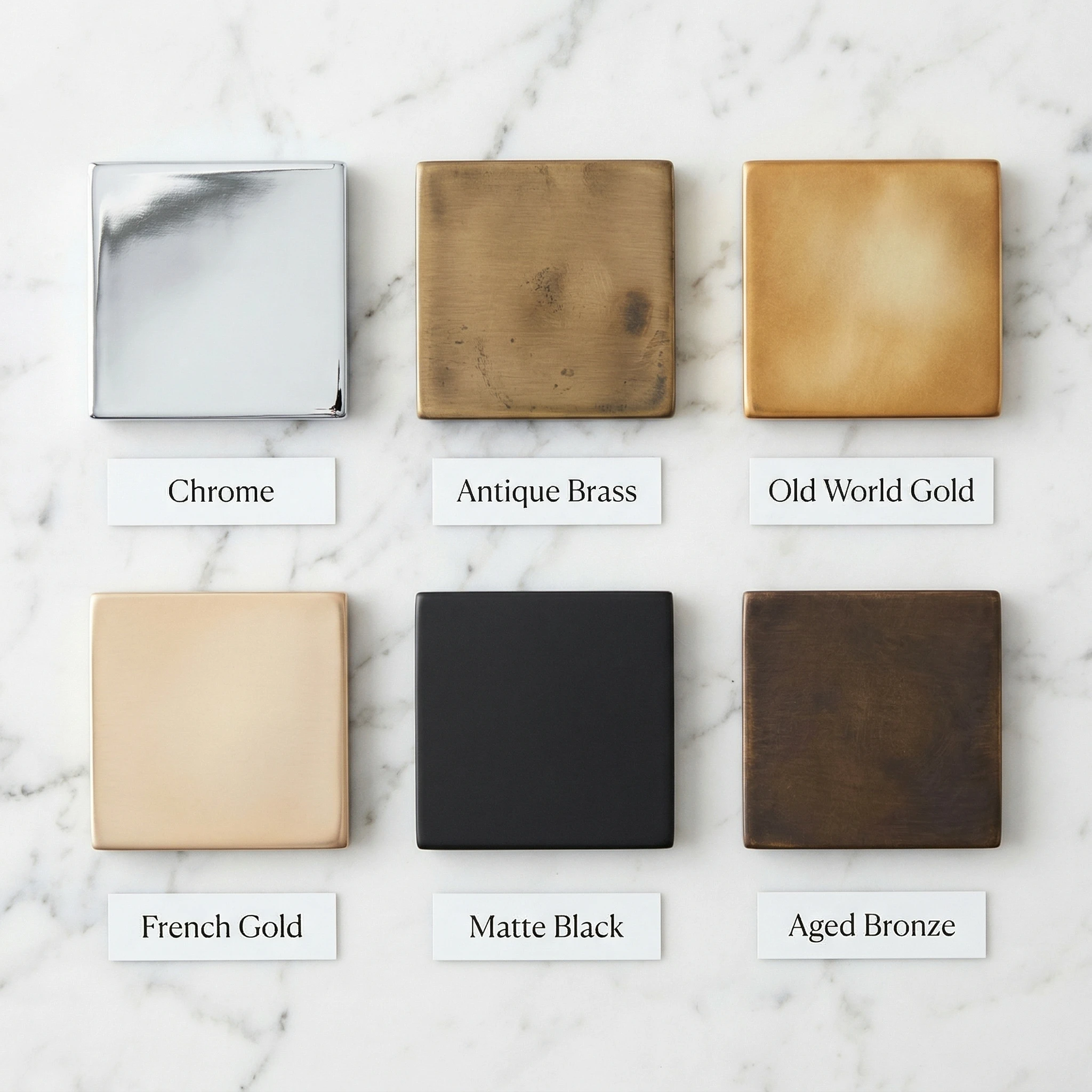
The metallic finish of your chandelier affects more than aesthetics — it determines how the fixture interacts with your room’s other hardware, your wall color, and your natural light conditions. We covered this in depth in our brass vs gold lighting guide, but here’s the chandelier-specific summary.
| Finish | Tone | Best Room Conditions | Pairs With |
|---|---|---|---|
| Chrome (CH) | Cool, bright | Modern, high-contrast rooms | White walls, grey tones, stainless steel |
| Antique Brass (AB) | Warm, muted | Traditional, transitional | Warm wood, leather, earth tones |
| Old World Gold (OWG) | Warm, luminous | Formal, opulent | Rich fabrics, marble, ornate architecture |
| French Gold (FG) | Warm, delicate | French country, refined spaces | Linen, pale wood, muted pastels |
| Matte Black (BLK) | Neutral, dramatic | Modern, industrial, transitional | Any wall color, bridges warm and cool |
| Aged Bronze (ABZ) | Warm, dark | Mediterranean, rustic | Terracotta, stone, wrought iron |
Pro tip: Your chandelier finish doesn’t need to match your other fixtures exactly — it needs to be in the same metallic temperature family. Antique brass chandelier with old world gold sconces? Beautiful. Chrome chandelier with antique brass sconces? Unsettling. Read our chandelier and sconce coordination guide for the full framework.
Chandelier Sizing by Room
Dining Room
The most consequential chandelier decision in most homes. Size it to the table, not the room. The chandelier should be half to two-thirds the table width, hanging 30-36 inches above the surface. For round tables, use the table diameter. For rectangular tables over 6 feet, consider a linear chandelier or a pair of smaller fixtures.
Dining chandeliers must be on a dimmer. Full brightness for task lighting during setup, dimmed for ambiance during dinner. Every lighting designer will tell you: a chandelier without a dimmer is a chandelier at half its potential.
Foyer and Entryway
Your foyer chandelier sets the tone for the entire home. Size it to fill the vertical space — in a two-story foyer, the chandelier should be visible and impressive from both the ground floor and the upstairs landing. Use the room dimension formula (length + width = diameter in inches), and don’t be afraid to go large. A foyer is the one room where an oversized chandelier is almost always better than an understated one.
Living Room
Living room chandeliers should complement, not dominate. In rooms with multiple seating areas or a fireplace as the focal point, a chandelier serves as ambient lighting rather than a centerpiece. Consider a fixture that’s slightly smaller than the room formula suggests, with a finish that recedes into the ceiling rather than demanding attention.
Bedroom
A bedroom chandelier is a luxury that transforms the room from functional to aspirational. Mini chandeliers (under 20 inches in diameter) work beautifully in bedrooms — the Versailles 4-Light Mini Chandelier in Antique Brass provides intimate sparkle without the scale of a dining fixture. Hang it directly over the foot of the bed or centered in the room, never directly over the pillows.
Bathroom
Yes, chandeliers belong in bathrooms — specifically in master baths with adequate ceiling height. A small crystal chandelier over a freestanding tub is one of the most photographed design moves in luxury interiors. Ensure the fixture is rated for damp locations (not wet — damp) and positioned at least 8 feet above the highest water point.
What Makes a Chandelier “Luxury”?
Price alone doesn’t determine quality. Here’s what separates a genuine luxury chandelier from a mass-market imitation at a similar price point:
- Crystal quality — genuine leaded crystal (Swarovski, Spectra, or equivalent) has a higher refractive index than glass or acrylic, producing sharper, more colorful light dispersion. You can see the difference in how the Chateau Imperial 8-Light Chandelier throws prismatic rainbows compared to a glass-crystal alternative.
- Metal construction — solid brass or cast metal frames vs. thin stamped steel. Solid construction means the arms don’t wobble, the finish doesn’t flake, and the fixture maintains structural integrity for decades.
- Finish depth — luxury finishes have multiple layers (primer, base coat, patina, lacquer) that create visual depth. Mass-market finishes are single-coat and look flat by comparison.
- Wiring and sockets — ceramic sockets rated for higher wattage, cloth-covered wiring, properly grounded junction boxes. These details affect safety, longevity, and the ability to use dimmer switches reliably.
- Chain and canopy quality — heavy-gauge chain that doesn’t stretch, a canopy (ceiling plate) that sits flush, and a mounting system engineered for the fixture’s weight.
Crystal Types: What You’re Actually Paying For
Not all crystal is created equal, and the differences matter more than most retailers will tell you. The crystal in your chandelier determines how light behaves in the room — how it refracts, how it sparkles, and whether those prismatic rainbows appear on your walls at sunset.
Leaded Crystal (Swarovski, Spectra)
The gold standard. Leaded crystal contains a minimum of 30% lead oxide, which increases the refractive index — the measure of how much light bends as it passes through the material. Higher refraction means sharper, more vivid prismatic effects. Swarovski crystals are machine-cut with 16 or more facets, producing consistent sparkle from every angle. You’ll find this quality in fixtures like the Versailles collection, where each crystal drop is individually cut and polished.
Expect to pay: 2-4x more than glass crystal alternatives. Worth it for rooms where the chandelier is the centerpiece.
K9 Optical Crystal
A lead-free alternative made from potassium oxide glass, originally developed for optical lenses. K9 crystal has excellent clarity and about 85% of the refractive performance of leaded crystal. It’s become the standard in mid-range luxury chandeliers — beautiful sparkle, reasonable price, and no lead content for households concerned about environmental impact.
Glass Crystal
Standard glass shaped and faceted to resemble crystal. Glass lacks the refractive index of true crystal — it sparkles, but the light it throws is less vivid, less colorful, and less dynamic. Glass crystal chandeliers photograph well but don’t produce the same live experience. If your chandelier hangs above 10 feet where close inspection is impossible, glass crystal can be a practical compromise.
Acrylic and Resin
Not crystal at all, but worth mentioning because it appears in some “crystal-style” fixtures. Acrylic doesn’t refract light — it transmits it. The visual effect is flat and lifeless compared to any real crystal. Avoid it entirely if you’re investing in a chandelier meant to last.
Layering Light Around Your Chandelier
A chandelier alone rarely provides enough light for a room. It creates ambiance and focal drama, but a well-lit room uses three layers of light working together — and your chandelier is only one of them.
Ambient Layer (Your Chandelier)
The chandelier provides the room’s general glow. On a dimmer at 60-70%, it creates warm ambient light that fills the space without harsh shadows. This is the layer most people think of first, but it shouldn’t work alone.
Task Layer (Recessed, Under-Cabinet, Reading Lights)
Recessed downlights or directional fixtures provide the brightness you actually need for tasks — reading, cooking, working. In a dining room, recessed lights around the perimeter supplement the chandelier. In a kitchen with a linear chandelier over the island, under-cabinet lights handle the countertop work. The chandelier sets the mood; task lights do the work.
Accent Layer (Sconces, Picture Lights, Uplights)
Wall sconces, picture lights, and uplights add depth and dimension. They create visual interest at eye level while the chandelier commands attention from above. This is where our chandelier and sconce coordination guide becomes essential — the accent layer needs to harmonize with the chandelier without competing.
The best lighting schemes let you control each layer independently. Three separate dimmer switches — chandelier, recessed, sconces — give you the flexibility to shift the room from bright task lighting to intimate dinner ambiance in seconds.
Installation: What to Know Before You Hang
A luxury chandelier is an investment that deserves professional installation. Here’s what to discuss with your electrician before the fixture arrives.
Weight and Structural Support
Most standard electrical boxes support fixtures up to 50 pounds. Many luxury chandeliers exceed this — the Bohemia 30-Light and multi-tier crystal fixtures can weigh 80-150 pounds. Heavy fixtures require a fan-rated or chandelier-rated junction box bolted directly to a ceiling joist, or a support brace spanning between joists. Never hang a heavy chandelier from a plastic electrical box — this is the most dangerous installation shortcut.
Electrical Requirements
Chandeliers with 8+ lights draw significant wattage. Confirm your circuit can handle the load, especially if you’re using incandescent bulbs. A 12-light chandelier with 60W incandescent bulbs draws 720 watts — nearly half the capacity of a standard 15-amp circuit. LED bulbs solve this problem entirely: the same 12-light fixture with 5W LED candelabra bulbs draws only 60 watts total.
Dimmer Compatibility
Not all dimmers work with all bulb types. If you’re using LED bulbs (recommended), install a dimmer rated specifically for LED loads. Standard incandescent dimmers cause LED bulbs to flicker, buzz, or fail to dim smoothly. Lutron’s Caseta and Diva lines are reliable choices that handle LED chandelier loads without issues.
Professional vs. DIY
Hire a licensed electrician for any chandelier that weighs more than 25 pounds, hangs from a ceiling higher than 9 feet, requires a new junction box, or involves any structural modification. The cost of professional installation ($200-$500) is trivial compared to the cost of the fixture — and compared to the cost of a chandelier that falls because the mounting wasn’t adequate.
Pairing Your Chandelier with a Ceiling Medallion
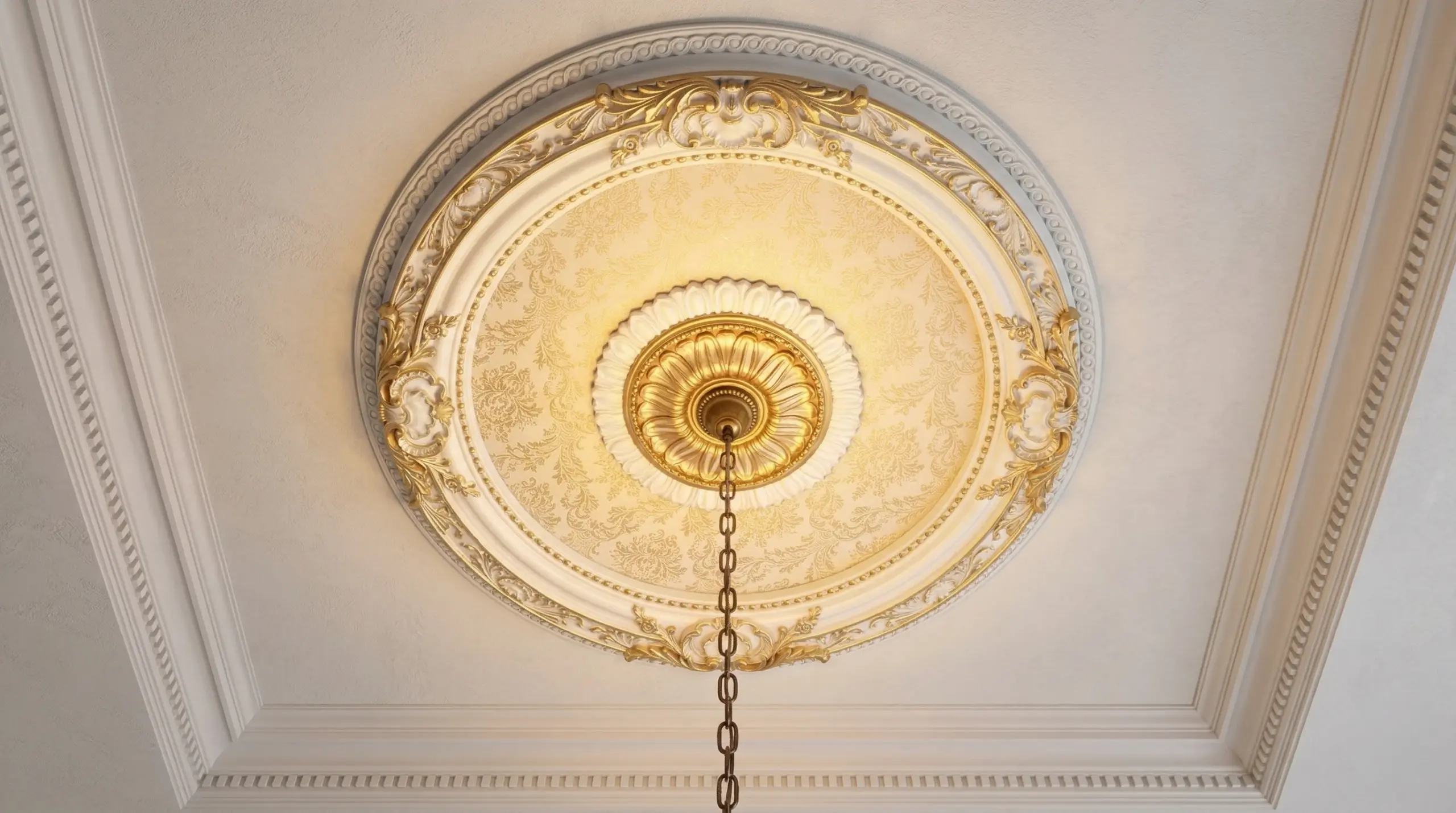
A ceiling medallion is the architectural frame for your chandelier — it defines where the ceiling ends and the fixture begins. In rooms with plain drywall ceilings, a medallion adds the visual weight and detail that makes a chandelier look intentional rather than simply “hung.”
Size the medallion to be slightly larger than the chandelier’s canopy but significantly smaller than the chandelier’s overall diameter. A 26-inch chandelier pairs well with a 26-inch medallion or a 24-inch Petite Blanco medallion. For grand fixtures, the Golden Dream 60-inch medallion creates the kind of ceiling architecture typically found only in historic homes.
Frequently Asked Questions
How much should I budget for a luxury chandelier?
Genuine luxury chandeliers typically range from $500 for small accent pieces to $15,000+ for grand multi-tier crystal fixtures. The sweet spot for a quality dining room chandelier is $1,500-$4,000 — enough to ensure solid construction, quality crystal, and a lasting finish without entering the ultra-high-end territory. Budget an additional $200-$500 for professional installation, especially for heavy fixtures or high ceilings.
Can I install a chandelier on a sloped ceiling?
Yes, with a sloped ceiling adapter (also called a vaulted ceiling mount). Most luxury chandeliers include an adjustable canopy that accommodates slopes up to 45 degrees. For steeper slopes, ask the manufacturer about compatible adapters. The chandelier should always hang plumb (vertically) regardless of the ceiling angle — the adapter compensates for the slope.
How do I clean a crystal chandelier?
For light dust, use a lambswool duster or compressed air every 2-4 weeks. For thorough cleaning, spray individual crystals with a chandelier cleaning solution (available at lighting retailers) and let them drip-dry onto a drop cloth. Never twist crystal components while cleaning — lift off, clean, and replace. Full cleaning is typically needed once or twice per year depending on your environment.
Should I choose LED or incandescent bulbs?
For crystal chandeliers, LED candelabra bulbs with a warm color temperature (2700K) produce the best results — they approximate the warm glow of incandescent bulbs while consuming a fraction of the energy. Avoid “daylight” (5000K+) LEDs in chandeliers; the cool white light kills the warmth that makes crystal sparkle. Always use dimmable LED bulbs if your chandelier is on a dimmer circuit.
What’s the difference between a chandelier and a pendant?
A chandelier has multiple light sources (arms, candles, or light points) radiating outward from a central structure. A pendant is a single light source suspended from the ceiling, often with a shade. Chandeliers are designed to be the focal point and provide ambient light across a wide area. Pendants are more focused, often used for task lighting over islands or in clusters. Browse our pendant collection if you’re considering both options.
Can I hang a chandelier in a room with 8-foot ceilings?
Yes, but choose carefully. Flush-mount or semi-flush chandeliers are designed specifically for lower ceilings, maintaining the visual impact of a chandelier without the drop that requires higher clearance. For standard chandeliers in 8-foot rooms, choose fixtures with a total height (including chain) under 24 inches, and hang them as close to the ceiling as the fixture allows while still achieving proper light distribution.
How many lights should my chandelier have?
Light count should match the room’s size and desired brightness. As a guideline: 3-6 lights for small rooms (under 150 sq ft), 6-12 for medium rooms (150-300 sq ft), and 12+ for large or dramatic spaces. But with dimmers and LED bulbs, you can always dim a fixture with more lights — you can’t brighten a fixture with too few. More light points also create more even ambient illumination.
Your Chandelier Shopping Checklist
Before you browse, measure. Before you buy, verify. This checklist ensures you don’t miss the details that matter.
- Measure your room — length and width in feet. Add them together for your target diameter in inches.
- Measure your ceiling height — this determines chain length and whether you need a flush-mount option.
- If hanging over a table — measure the table width. Your chandelier should be 50-66% of that measurement.
- Identify your style — traditional crystal, contemporary, linear, or rustic. Match to your room’s existing architecture.
- Choose your finish family — warm metals (brass, gold, bronze) or cool metals (chrome, nickel). Coordinate with existing hardware.
- Check the fixture weight — anything over 50 lbs needs a reinforced junction box. Confirm before your electrician arrives.
- Plan your bulbs — LED candelabra, 2700K, dimmable. Order them with the chandelier so they arrive together.
- Install a compatible dimmer — LED-rated, matching the total wattage of your bulb configuration.
- Consider a ceiling medallion — especially if your ceiling is plain drywall. It frames the fixture and adds architectural weight.
- Book professional installation — for any fixture over 25 lbs, any ceiling over 9 feet, or any new electrical work.
Choosing a luxury chandelier is equal parts technical sizing and creative expression. The formulas give you the parameters; your eye and your space tell you which fixture belongs. Browse our complete chandelier collection to explore traditional crystal, contemporary designs, and statement pieces across every finish and price point — or reach out to our concierge team for personalized guidance on sizing, finish coordination, and installation planning.